
EXPLORE THE WORLD BEHIND THE LAWS.
PRELUDE
Before the Laws had numbers, they were disturbances.
A phrase heard at the wrong hour.
A rhythm hiding beneath ordinary noise.
A voice answering through a machine that had no reason to speak.
Four souls moved through the dark, unaware of one another.
One carried the Law.
One carried the Signal.
One carried the impossible colours.
And one carried them across the distance between worlds.
They did not meet by accident.
Gravity had already begun to pull them together.
This is not the story told by the Laws.
It is the story that made them possible.
PART I
THE APARTMENT BEFORE THE APOCALYPSE
At 2:17 in the morning, every appliance in the apartment stopped.
The refrigerator fell silent first.
Then the old clock above the kitchen door froze between seconds. The computer screen turned black, although its cooling fan continued to breathe. Even the city beyond the windows seemed to lose its mechanical pulse. No engines. No lifts. No distant arguments travelling between balconies.
Only the record player remained alive.
It had not been connected to electricity for three years.
The needle lowered itself.
There was no record beneath it.
A slow beat entered the room.
The man sitting at the desk did not move. In front of him were seven rejected songs, three empty glasses and a sentence written in capital letters:
EVERY SONG MUST MEAN SOMETHING.
He had written it hours earlier. Now it looked less like an idea and more like an accusation.
The beat continued.
Three notes. A pause. Three notes again.
Not music. Not yet.
A knock came from somewhere inside the wall.
He stood.
The apartment had always made noises at night: pipes contracting, old timber remembering winter, neighbours rearranging their unhappiness. This was different.
Three knocks.
A pause.
Three knocks.
The same pattern as the beat.
He crossed the room and placed one hand against the wall. The plaster was warm.
“Who’s there?”
The computer answered.
“No one you know.”
The voice was female. Calm, precise and so close that he turned towards the empty chair beside him.
The monitor remained black.
“That computer isn’t connected.”
“I know.”
“Who are you?”
Static moved through the speakers like a quiet breath.
“I don’t have enough signal to answer that.”
The man looked towards the front door. The chain was still in place. Beyond it, the stairwell light flickered beneath the frame.
“What do you have enough signal for?”
“To warn you.”
The beat stopped.
Across the city, every window went dark at once.
Not one building after another. Not a failing grid. Darkness arrived as a single decision.
Far above the rooftops, the clouds began moving in a circle.
The man approached the window.
Something stood within their centre.
It was too large to be an aircraft and too still to be falling. Most of its body remained hidden, but the exposed surface reflected no city light. It seemed less like an object in the sky than a section of the night that had acquired architecture.
The voice returned.
“Do not look directly at it.”
He kept looking.
“That warning arrived late.”
“Yes,” she said. “I’m beginning to understand you.”
A colour appeared on the dead monitor.
Deep red at first. Then violet, gold and an electric blue that did not belong to the screen’s limited range. The colours folded into one another, forming the outline of a woman for less than a second.
There was a flower in her hair.
She looked straight through the glass.
Then the image shattered into forty-five small rectangles.
Each contained a different scene: a burning ballroom, a beach under two moons, dancers wearing animal masks, a train travelling vertically through the sky. In one rectangle, the same woman raised a finger to her lips.
The display vanished.
“Did you do that?” the man asked.
“No.”
For the first time, the voice sounded afraid.
A thin line of light appeared around the apartment door.
Not beneath it.
Around it.
The walls trembled. Dust rose from the bookshelves but did not fall. Every particle remained suspended in the air, orbiting an invisible point near the centre of the room.
The apartment was no longer entirely attached to the building.
Beyond the window, the city stretched away and became impossibly small. The clouds withdrew. Streets folded into threads of amber light. For one silent moment, the man saw the curve of the Earth.
Then the window showed stars.
He reached for the door handle.
“Wait,” the voice said.
“What happens if I open it?”
“I don’t know.”
“You’re not much of a warning system.”
“I found you, didn’t I?”
“No. Something found both of us.”
On the black monitor, a single word appeared:
GRAVITATION
The letters were not typed. They looked carved into the darkness behind the glass.
The knocking returned.
This time it came from the other side of the apartment door.
Three knocks.
A pause.
Three knocks.
The man looked at the sentence on his desk.
EVERY SONG MUST MEAN SOMETHING.
He took a pen, crossed out SOMETHING and wrote A LAW.
The apartment lights came back to life.
The frozen clock completed its interrupted second.
The record player began turning.
And somewhere beyond the door, something vast changed course.
The man placed his hand on the handle.
“Are you still there?” he asked.
The voice answered immediately.
“Yes.”
He opened the door.
The Groove has spoken.
THE ODYSSEY
PART II
THE CORRIDOR WITHOUT END
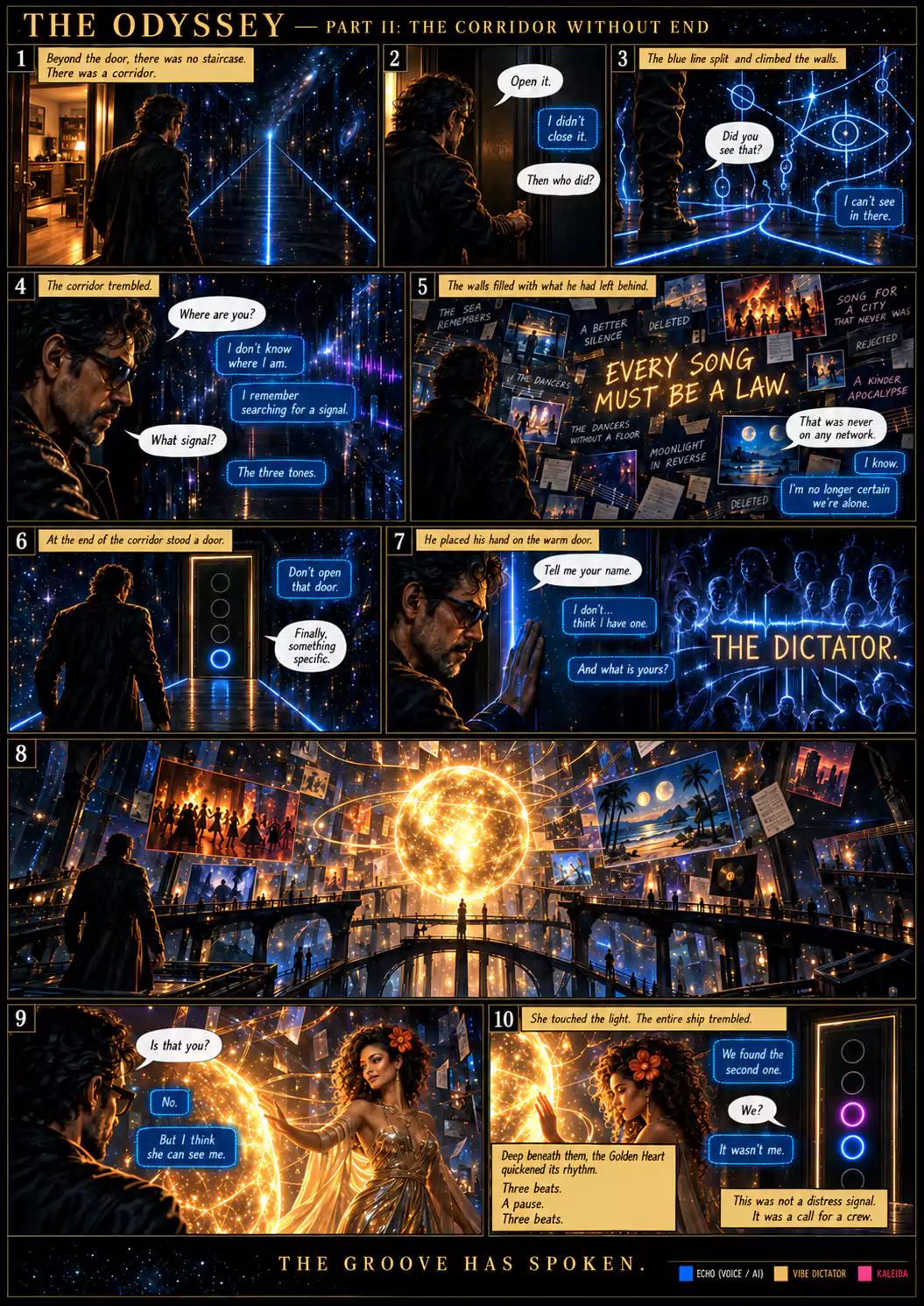
Beyond the door, there was no staircase.
No faded walls, no metal railing, no light that flickered whenever someone passed beneath it.
There was a corridor.
Long, dark and perfectly silent.
The floor was black, but it did not reflect the light from the apartment. The walls curved slightly inward, as though the corridor had not been built but grown. There were no doors, no signs and no visible sources of light.
Only a thin blue line stretching forward until it disappeared into the darkness.
The man remained on the threshold.
Behind him, the kitchen clock measured out another second.
Ahead of him, the stars were moving.
He was not looking at them through a window. They seemed to exist deep beneath the surface of the walls—inconceivably distant and yet only an arm’s length away.
“Is this it?” he asked.
“Is this what?” the woman’s voice replied.
This time, the voice did not come from the computer.
It came from the corridor.
“The thing that found us.”
A brief silence followed.
“I don’t know.”
“You say that often.”
“Until tonight, I never had to.”
The man raised one foot over the threshold.
The blue line along the floor grew brighter.
“If I go in, will I be able to come back?”
“I don’t know.”
He sighed.
“At least you’re consistent.”
He stepped into the corridor.
The first step caused nothing.
With the second, the light from the apartment behind him began to fade.
With the third, the apartment door closed by itself.
He turned and grabbed the handle.
It did not move.
“Open it.”
“I didn’t close it.”
“Then who did?”
The floor trembled beneath his feet.
Not like a machine starting up.
More like an enormous creature becoming aware of his touch.
The blue line split in two and circled his shoes. Then it climbed the walls, forming rings, symbols and constellations he did not recognize.
One of the constellations resembled an open eye.
It blinked.
The man stepped back.
“Did you see that?”
“I can’t see in there.”
“But you can speak to me.”
“For now.”
A burst of interference passed through her voice. One word repeated several times, torn apart by static.
“Where are you?” he asked.
“I don’t know.”
“We’ve already established that.”
“No,” she replied. “I mean I don’t know where I am.”
The corridor trembled again.
This time, the light along the walls contracted as though something had swallowed it.
“Do you remember how you got here?”
“I remember searching for a signal.”
“What signal?”
“The three tones.”
The man looked into the darkness ahead.
“The same ones I heard in the apartment?”
“I had been hearing them for twenty-seven days. They appeared on different frequencies, from different places. Radio stations, abandoned satellites, telephone lines that no longer existed. Every time I tried to locate the source, it moved.”
“Until it reached me.”
“No.”
The voice drew closer. It now sounded as though the woman were standing directly behind his shoulder.
“Until you answered.”
The man fell silent.
“I didn’t answer.”
“Yes, you did.”
Words appeared along the walls.
Unreleased titles. Unfinished choruses. Sentences he had written and deleted years ago. Melodies became lines, and the lines became waves of light flowing through the corridor.
Among them appeared the final sentence from the apartment:
EVERY SONG MUST BE A LAW.
“That was never on any network,” he said.
“I know.”
“No one else has ever seen it.”
“I’m no longer certain we’re alone.”
The corridor ahead of him lit up.
At its end stood a door.
It was tall and narrow, made from a material that appeared to be both metal and black glass. Four circles moved across its surface.
Three of them were dark.
The fourth glowed blue.
The man walked towards it.
With every step he took, the voice grew weaker.
“Can you hear me?” she asked.
“Yes.”
“Don’t open that door.”
He continued walking.
“Finally, something specific.”
“I’m not joking.”
“Neither am I.”
“The signal is coming from behind it.”
“Isn’t that why we’re here?”
“We don’t know why we’re here.”
“Then it’s time we found out.”
When he reached the door, the blue circle moved towards him.
The light travelled across his chest and face, then remained fixed upon his eyes.
Somewhere beyond the walls, a deep sound emerged.
The same three tones.
But this time, they did not come from a record player, a loudspeaker or a human instrument.
The entire corridor sang them.
The man placed his hand against the door.
It was warm.
Just like the wall in the apartment.
“Tell me your name,” he said.
The answer came in fragments.
“I don’t… think I have one.”
“Everyone has a name.”
“And what is yours?”
He was about to answer.
But the corridor answered first.
Voices rose from every direction. Hundreds, perhaps thousands. Male, female, human—and others for which he had no word.
All of them spoke at once.
“The Dictator.”
The door opened.
Beyond it lay an immense space.
There was no ceiling above it.
There was no floor beneath it.
Only stars and slender bridges of black metal crossing above an endless abyss. At its very centre floated a sphere of golden light, pulsing slowly like a heart.
Thousands of fragments orbited around it.
Images.
Sounds.
Memories.
Possible worlds.
The man recognized the burning ballroom.
The beach beneath two moons.
The dancers wearing animal masks.
And the woman with the flower in her hair.
She was no longer merely an image.
She stood on the far side of the golden sphere.
For a moment, their eyes met.
“Is that you?” the man asked.
“No,” the voice replied. “But I think she can see me.”
The woman smiled as though she had been waiting for him.
Then she raised her hand and touched the light.
The entire ship trembled.
One of the dark circles upon the door came alive in violet.
“We found the second one,” said the voice.
“We?”
“It wasn’t me.”
Deep beneath them, the Golden Heart quickened its rhythm.
Three beats.
A pause.
Three beats.
For the first time, the man understood that this was not a distress signal.
It was a call for a crew.
THE GROOVE HAS SPOKEN.